


How Do Lightning Discharges Occur?
Types of discharge
90% of the lightning discharges between a cloud and the ground are lightning from the cloud to the ground with negative polarity.
Lightning starts in the negatively charged area of the cloud and extends towards the positively charged earth ground. Other types of discharge:
-
Lightning from ground to cloud with negative polarity
-
Lightning from cloud to earth with positive polarity
-
Lightning from ground to cloud with positive polarity
But most discharges occur within a cloud or between several clouds.
Formation of lightning discharges
When warm and humid air masses rise, the moisture in the air condenses and ice crystals form at higher altitudes. Storms can occur when clouds expand to heights of up to 15,000 m. Strong airflow from bottom to top, reaching a speed of up to 100 km per hour, causes light ice crystals to reach the upper parts and hailstones to reach the lower part. As a result of impact and friction, load separations occur.
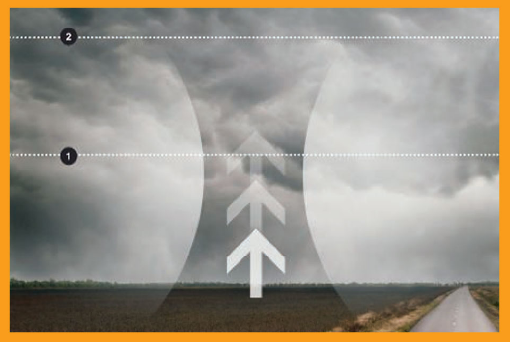
Formation of lightning discharges: 1 = Approx. 6,000 m, approx. -30 °C, 2 = Approx. 15,000 m, approx. -70 °C
Negative and Positive charges
In the researches, it has been determined that the falling hail particles (the part warmer than -15 ° C) are charged with negative charges, and the ice crystals that go up (the part colder than -15 ° C) are charged with positive charges.
Light ice crystals are carried to the upper regions of the cloud by the air flow from the bottom up, and the hailstones fall into the central parts of the cloud. Thus, the cloud is divided into three regions:
-
Top: Positively charged region
-
Middle: Narrow, negatively charged region
-
Bottom: Weak, positively charged region
This load separation creates tension in the cloud.
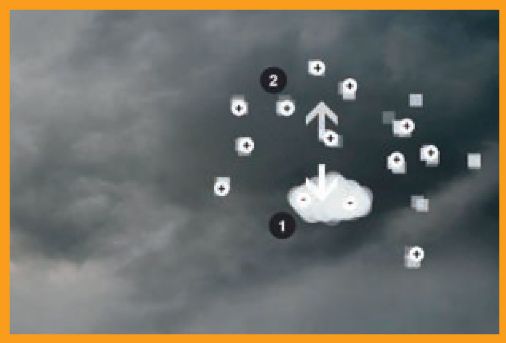
Negative and positive charges: 1 = Full, 2 = Ice crystals
Load distribution
Typical load distribution:
-
The upper region has positive charges, the middle has negative charges, and the lower region has weak positive charges.
-
Areas close to the ground have positive charges.
-
The field strength required for the formation of a lightning depends on the insulation ability of the air and is in the range of 0.5 to 10 kV/cm.
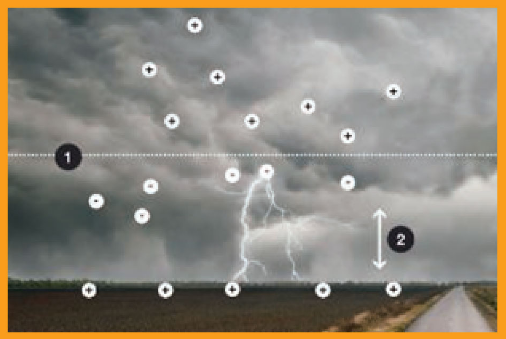
Charge distribution: 1 = approx. 6,000 m, 2 = Electric field